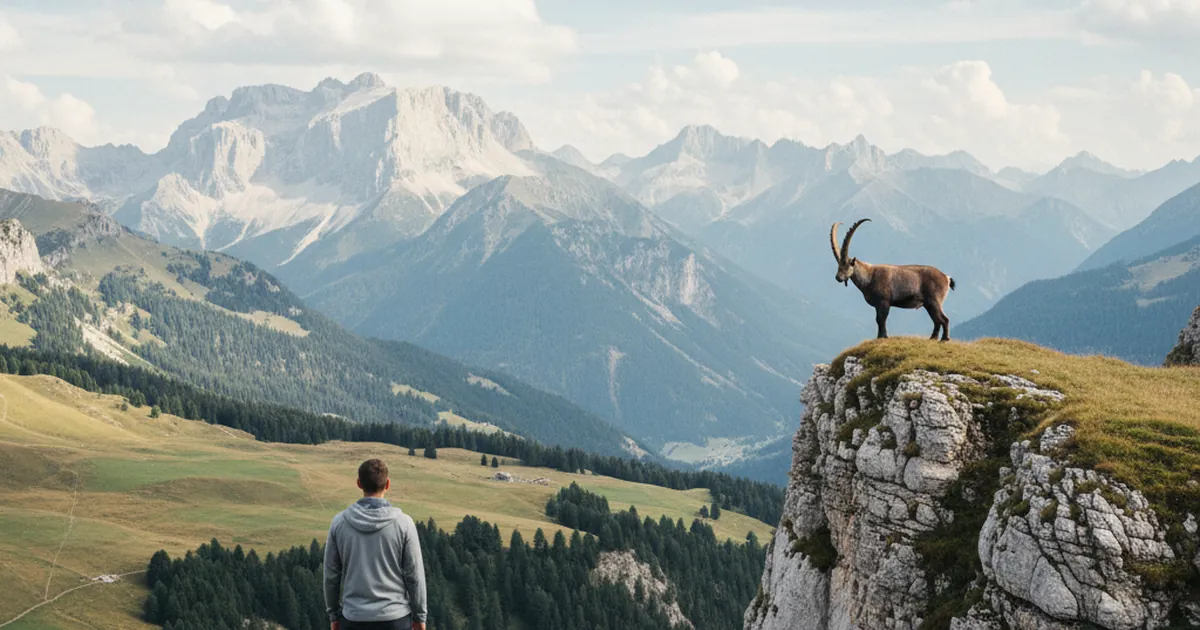
Spotting an Alpine ibex in the mountains is one of those encounters you don't forget. Picture a creature weighing close to 100 kilos balanced on a narrow ledge above a sheer drop, its long ridged horns pointing skyward, watching you with almost regal indifference. To give yourself a real chance of that encounter while hiking in the Haute-Savoie Alps, you need to know where to look, when to go, and how to behave.
Back from the brink
The Alpine ibex came dangerously close to extinction in the 19th century. Intensive hunting had reduced the entire world population to a few hundred animals, all of them confined to the Gran Paradiso massif in Italy. Protection by the House of Savoy and later the Italian state saved the species. France began reintroduction programmes in the 1960s, starting with the Vanoise National Park. Since then, populations have spread across the French Alps. Today several thousand ibex live in the mountains of France, including established colonies in Haute-Savoie.
Rocky ground: the ibex habitat
The ibex is an animal of steep, rocky terrain. In summer it moves above 1,500 to 2,000 metres, favouring limestone cliffs alternating with grassy slopes. It is completely at home on ledges and rock faces where even a chamois would think twice. Those clifftop habits offer natural protection from predators. In winter, ibex descend to lower, sun-facing slopes where the vegetation is not completely buried under snow.
An adult male can weigh between 80 and 120 kilos. The horns of an old buck can exceed a metre in length. Females are noticeably smaller with much shorter horns, a difference visible at a distance that makes sexing the animals relatively easy.
Where to look in Haute-Savoie
The Chablais massif holds well-established ibex populations. The high-altitude terrain around Morzine, particularly towards the Hauts-Forts summit area, is one of the sectors where sightings are regularly reported. A route such as the Boucle des Hauts-Forts takes you above 2,400 metres into exactly this kind of rugged, rocky landscape where ibex feel at home.
The Vallée du Giffre also offers promising territory. The high-altitude zones above Sixt-Fer-à-Cheval and the wilder reaches of the valley floor can produce memorable encounters. The Pointe de Ressachaux trail, climbing open slopes above Morzine, is another route worth exploring.
Bear in mind that no sighting is ever guaranteed. A ridge that was empty yesterday can be alive with ibex today, and vice versa. Observation depends partly on luck, but also on moving quietly and scanning the terrain with binoculars before you get close.
Best time and best hours
Spring and early summer offer the most favourable conditions. Ibex are active, males begin grouping together, and females sometimes have young kids alongside them. In July and August, heavy trail traffic can push animals onto even steeper, less accessible ground.
The best observation windows are early morning, in the first hours after sunrise, and late afternoon before the light fades. At midday, ibex often rest in the sun, wedged against a rock face on a south-facing slope. That is sometimes how you spot them: a motionless silhouette on a ledge that gradually separates from the stone around it.
Watching without disturbing
Ibex are often described as less skittish than chamois. They will sometimes let you approach to a reasonable distance without bolting. That apparent calm does not mean they are stress-free. Disturbance during the birthing season (late May to early July) or the rut (December to January) can have real consequences for the animals.
- Stay at least 50 metres away, even if the animal seems unbothered.
- Do not cut between an animal and where it is heading.
- No shouting, no sudden movements.
- If you have a dog, keep it on a lead at altitude.
- Use binoculars rather than trying to close the gap.
You cannot order up an ibex sighting, but you can prepare for one. A rocky, high-altitude sector in the Chablais or the Vallée du Giffre, an early start, a pair of binoculars, and some patience: that combination gives the mountains a real chance to deliver.