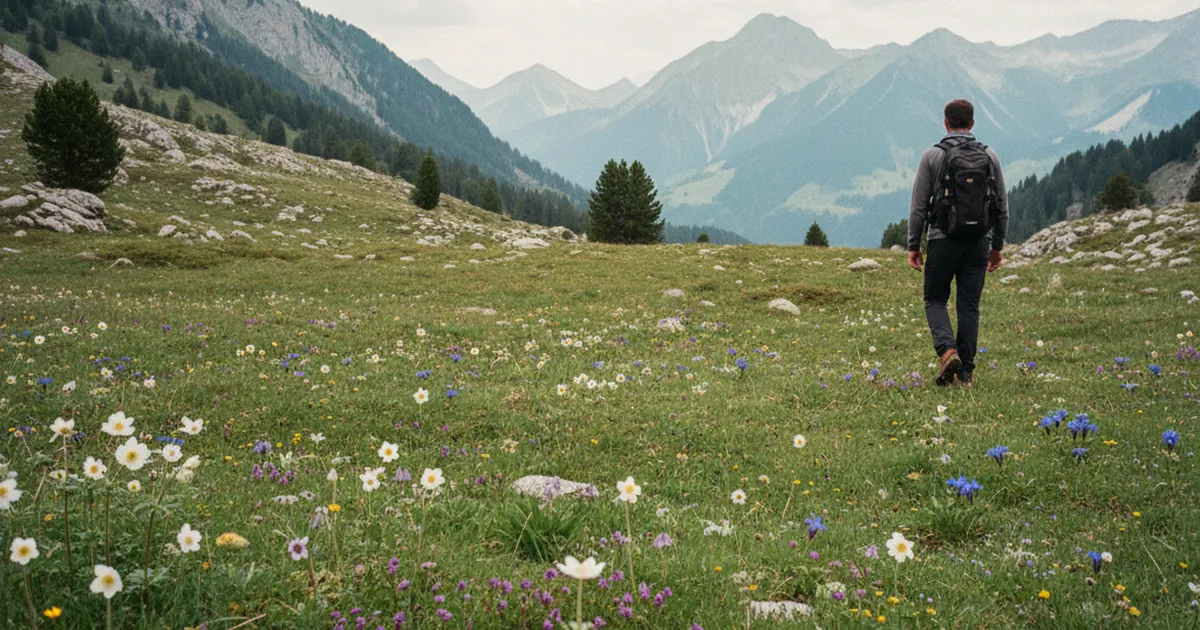
Alpine flora is just as captivating as the views. In Haute-Savoie, once you pass 1500 metres, the mountain pastures burst into colours you simply won't find in lowland meadows. Learning to identify a short list of flowers quickly turns you into an attentive observer, and every outing becomes as much an inventory as a walk. To hike in Haute-Savoie at the right moment for flowers, aim for June and July when the bloom is at its peak.
A shifted calendar
In the mountains, spring arrives late. The first flowers push through the snow as early as April and May at altitude, while the trails are still partly buried. This lag produces striking contrasts: a patch of colour against a white background, a compressed flowering season squeezed into a few weeks. The higher you go, the shorter the season. Some species have only six to eight weeks to flower, fruit and set seed before the first frosts of September.
10 flowers to recognise
- Trumpet gentian (Gentiana acaulis). Deep blue, almost violet, sitting directly on the ground. It favours calcareous grasslands between 1500 and 2500 m. One of the easiest to identify because of the size of the flower relative to its very short stem.
- Alpine snowbell (Soldanella alpina). A tiny fringed violet bell that often pierces melting snow. It flowers right at the edge of the snowfield, and finding one still half-buried in early June is a common experience.
- Spring pasqueflower (Pulsatilla vernalis). White on the outside, flushed with violet, covered in a silky down. It grows on acidic grasslands between 1800 and 2800 m, appearing just after the snow melts. Its cottony look makes it easy to spot.
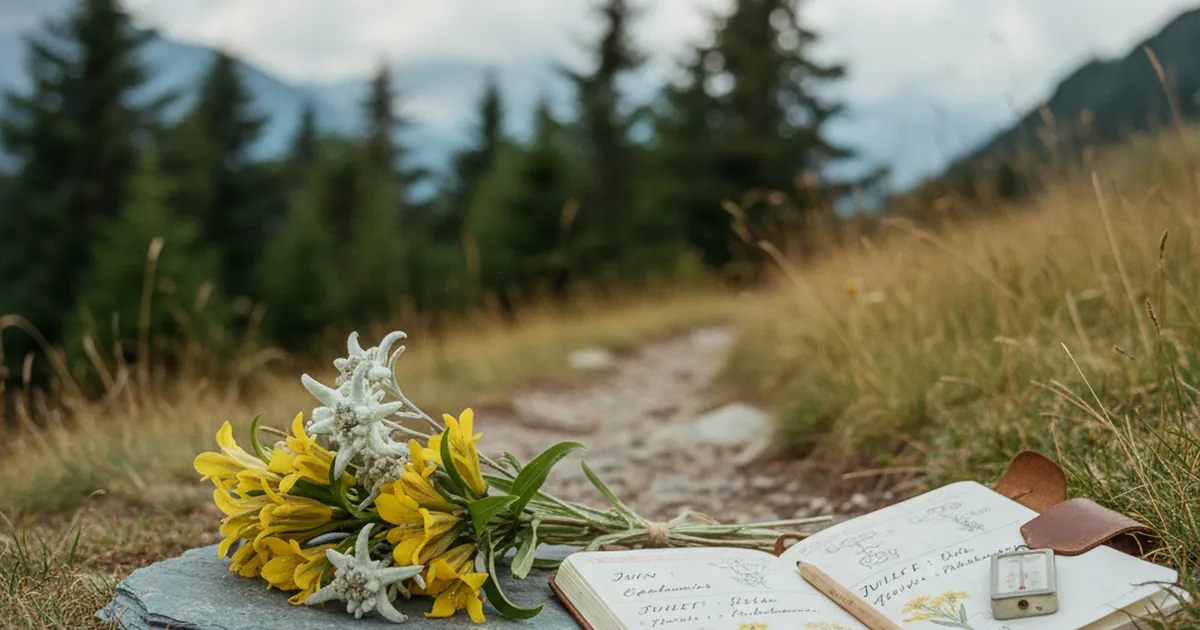
- Edelweiss (Leontopodium alpinum). Protected, illegal to pick, and often romanticised. Its star-shaped white woolly bracts are unmistakable. It grows on rocky calcareous terrain between 1700 and 3000 m. You will see it more often than you expect if you step off the busiest paths.
- Arnica (Arnica montana). A large, orange-yellow capitulum, a smaller cousin of the sunflower. It grows in acidic meadows and heathlands between 800 and 2500 m, often in patches. Used in herbal medicine for centuries, it is protected in several French departments.
- Martagon lily (Lilium martagon). Its pink and violet brown-spotted flowers hang downward in a distinctive turban shape. It grows in woodland clearings and mountain meadows between 600 and 2000 m. One of the rare alpine flowers that prefers a little shade.
- Bird's-eye primrose (Primula farinosa). Pale pink with a yellow throat, its stem dusted with a white powder. It colonises wet meadows and peat bogs between 1000 and 2500 m. Its delicacy contrasts with the harsh conditions of high-altitude wetlands.
- Alpenrose (Rhododendron ferrugineum). Not a single flower but a shrub with bright fuchsia-pink blooms that forms large patches between 1500 and 2800 m. Its evergreen leaves, rust-brown on the underside, give it its name. In July it colours whole hillsides.
- Scheuchzer's bellflower (Campanula scheuchzeri). A slender blue-violet bell on grasslands and scree between 1500 and 2800 m. There are many bellflower species in the mountains, but this is the most common at high altitude.
- Yellow gentian (Gentiana lutea). A tall, robust plant with whorled yellow flowers reaching up to 2300 m. Its root has been used since antiquity to make digestive bitters. It is legally protected in several French regions.
Where to find them in Haute-Savoie
The variety differs considerably from one massif to the next. In the Arve valley, the slopes of the Faucigny offer rich pastures from 1500 m upwards. In the Pays du Mont-Blanc, south-facing high-altitude terraces concentrate the rarest species. If you want an accessible starting point, the La Tournette from Montmin trail offers a gradual ascent through several distinct vegetation zones, from the beech forests at the base to the calcareous grasslands near the summit. For wetland species, the Lac de Gers, Refuge de Sales and Tête Pelouse route passes through particularly rich peat bog areas full of primroses and cotton grass.
From Talloires-Montmin, steep starts allow you to reach calcareous grasslands in under an hour. From Thônes, the enclosed valleys of the Aravis massif lead to wet hollows that suit bird's-eye primrose and wild orchids.
How to observe without disturbing
Never pick a flower you have not confidently identified. Several species are legally protected, and some that look common may not be in every massif. Edelweiss, arnica, yellow gentian: picking is prohibited in France. A fine is possible, but more importantly, a picked plant will not set seed that year.
Stay on the paths in areas with fragile grassland. An alpine meadow takes years to recover from repeated trampling. Wetlands are especially vulnerable: even a group walking the same line repeatedly destroys the sphagnum moss and alters the local hydrology.
If you are out with children, sketching and photographing works far better than picking. A laminated field guide in the pack is enough to identify most common species. The high pastures of Haute-Savoie are among the richest environments in Europe for plant diversity. Every walk at altitude is a chance to understand the fragile balances that keep these ecosystems alive.