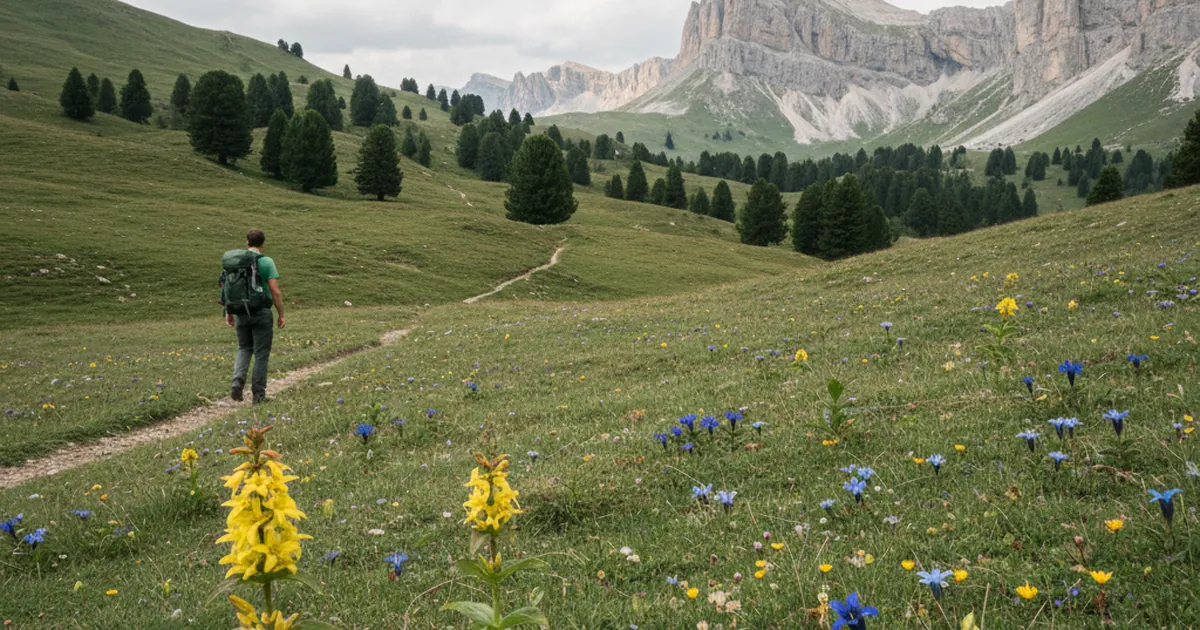
Gentians are among the most striking plants you will encounter in the Alps: tall yellow spikes rising from mountain paths, deep-blue trumpet flowers pressed low into a damp meadow, tiny violet stars scattered across limestone grasslands. In Haute-Savoie, several species grow at different altitudes, in different seasons and on different soil types. Knowing how to tell them apart adds a whole new dimension to any hike on the trails of Haute-Savoie, and gives you a solid reason to observe rather than pick.
Yellow gentian: the alpine landmark
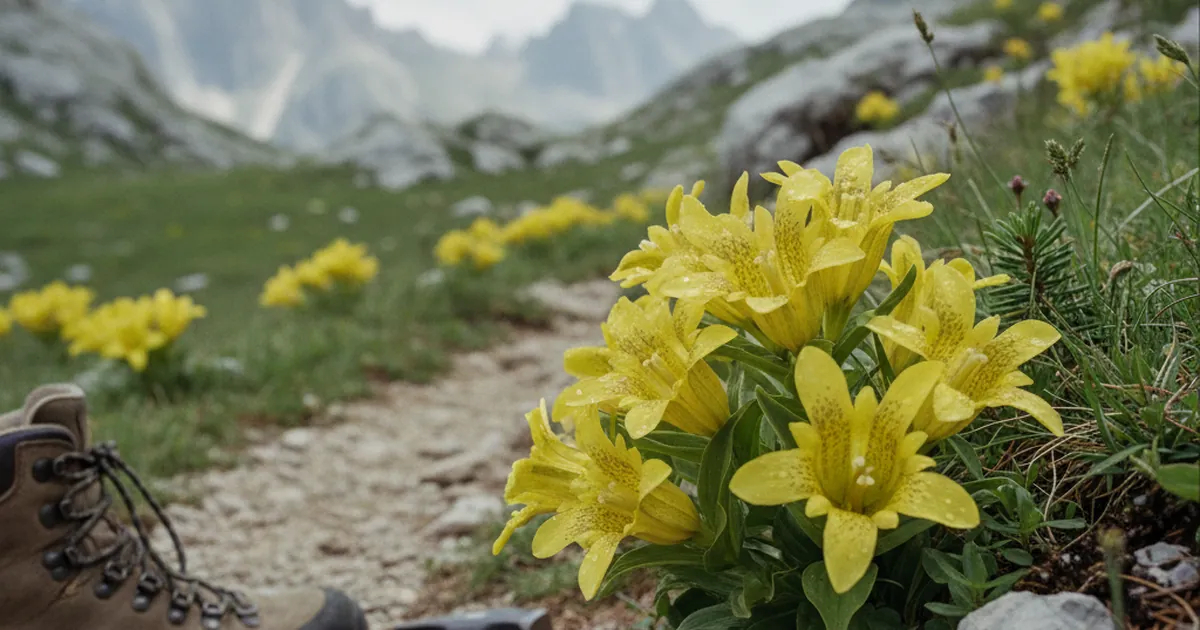
This is the tallest of the lot. Gentiana lutea can reach one and a half metres in good conditions. It grows in alpine meadows and pastures between 800 and 2,500 metres, usually on well-drained calcareous soils. The plant is hard to miss: a thick hollow stem, large opposite leaves with prominent veins, and yellow flowers clustered in whorls along the upper stalk. It blooms from July to August.
One key fact: yellow gentian takes between 7 and 10 years to flower for the first time. Its root has been used for centuries to make bitters and liqueurs (it is one of the base ingredients in Suze, among others). Precisely because of this history of harvesting, it is now a protected species in France: uprooting or picking it is illegal. In the Aravis and Bornes ranges, you will find it regularly above 1,500 metres on south-facing grassy slopes.
Acaulis gentian: an enormous flower on a tiny plant
Gentiana acaulis (also known as Koch's gentian, Gentiana kochiana) is the exact opposite in terms of scale. The flower is a deep electric blue, trumpet-shaped and up to 5 to 7 cm long, carried on a stem so short that the plant barely clears the ground. The leaves form a low rosette. The contrast between the impressive flower and the diminutive plant is genuinely striking.
It flowers early, from April through June, in unfertilised meadows and alpine grasslands. Hiking in May through the Bauges, around the pastures near Allèves, you are likely to find it in damp grasslands between 900 and 1,600 metres.
Purple gentian and field gentian
Gentiana purpurea resembles yellow gentian in habit, but its flowers are deep reddish-purple inside, sometimes greenish-yellow on the outside. It prefers acidic soils at high altitude and is more common on the Swiss side of the Alps, though a few populations exist in Haute-Savoie, particularly towards the Mont-Blanc area.
Gentianella campestris, the field gentian, is smaller and more understated. Its flowers are pale lilac with four petals, unlike the five-petal structure found in most other gentians. It blooms from July to September in dry meadows and upland pastures between 1,000 and 2,500 metres, and is gradually disappearing from lowland areas as intensive farming removes its habitat.
Spring gentians: the ones you can walk straight past
Gentiana verna, the spring gentian, is one of the most beautiful and one of the smallest. Its five-petalled flower is an intense sky blue, star-shaped, just a few centimetres across. It blooms from April onwards in calcareous grasslands and damp meadows between 600 and 2,500 metres. It is so compact that it is easy to miss if you are not watching the ground carefully.
Gentiana ciliata, the fringed gentian, is distinctive for its blue-violet petals with fringed edges. It flowers later, from August to September, in dry calcareous meadows and high-altitude forest edges. To observe these quieter species, a hike like La Figlia from Allèves in the Bauges takes you through exactly the right terrain: lean meadows, limestone grasslands, unfertilised alpine pastures. The Annecy-Bauges area combines the altitude range and substrate diversity that support this kind of floristic richness.
Why you should not pick gentians
They are slow-growing, sensitive to disturbance, and frequently protected by law.
- Yellow gentian takes a decade to flower. Picking or uprooting it destroys ten years of growth.
- Several species are protected at national or regional level in France. Collection, uprooting and commercial use are all prohibited.
- The meadows where they grow are fragile habitats, often within Natura 2000 protected zones. Trampling the surrounding vegetation to get a better photograph is enough to cause real damage.
- Gentians play a key role in alpine pollination. Bumblebees, their main pollinators, are morphologically adapted to the tube-shaped flowers.
The approach is simple: observe, photograph, identify, and leave without a trace.
When and where to find them
The timing varies: spring gentian from April, acaulis gentian in May and June, yellow gentian in July and August, fringed and field gentians from August to September. You can follow the thread of gentians across the entire hiking season. The richest habitats are unfertilised calcareous meadows between 900 and 2,000 metres and alpine pastures. A walk up to la Tournette from Montmin or to the high chalets above Talloires-Montmin puts you in terrain where several species can be found side by side.
Gentians are more than a photogenic subject. They are indicators of low-intensity farming, markers of ecologically intact alpine grasslands, and a resource for pollinating insects. The next time you spot one on a path, take a moment to count its petals, check whether the leaves are opposite or in a rosette, and note the exact shade of its colour. Those small details are what allow you to name the species, and to read the landscape around you a little more clearly.