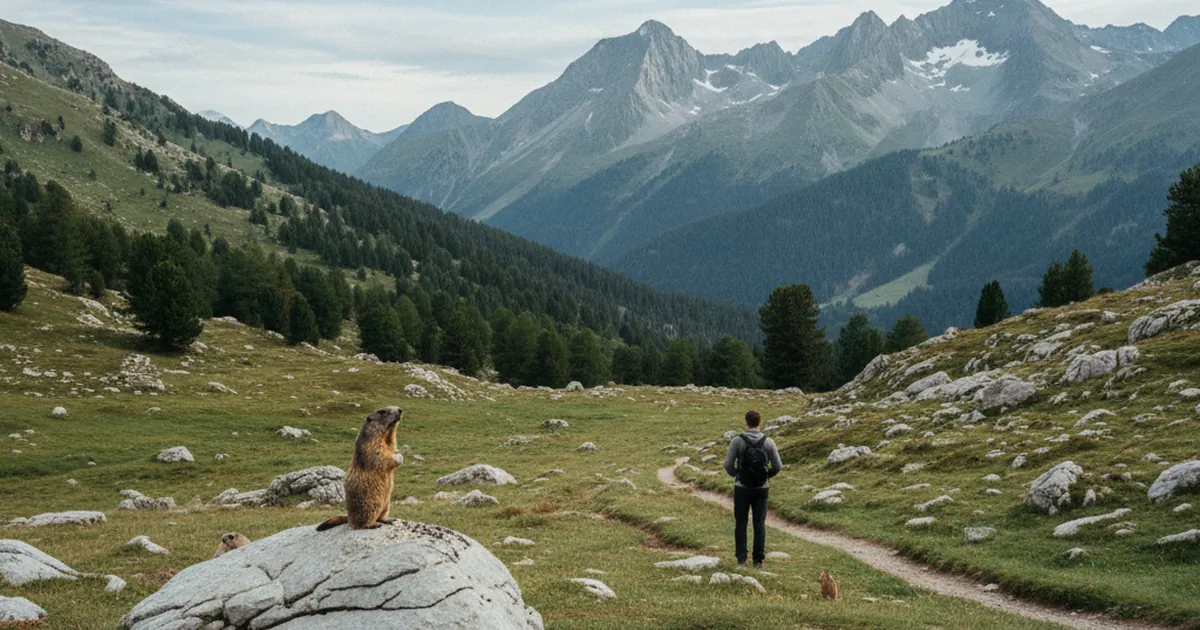
You're walking an alpine trail when a piercing whistle cuts through the silence. Two seconds later, the whole colony has vanished underground. Welcome to the world of the Alpine marmot: a social rodent that has turned communication into a survival art. If you enjoy hiking in the French Alps, you've probably startled a colony or two without ever quite understanding what they were saying to each other. Here's a small guide to decoding their calls.
The whistle: the marmot's primary tool
Alpine marmots live in family groups on grassy slopes between roughly 1,500 and 2,500 metres. In that communal life, shared vigilance is everything: predators are numerous and often fast. The whistle is their evolved answer to that constant pressure. Produced by forcing air through the teeth, it carries far across open alpine meadows and cuts through mountain winds without getting lost.
It is not a single, uniform alarm call. Researchers have identified several distinct call types based on the nature and urgency of the perceived threat. Colony members also appear to adjust their response according to the experience and position of the sentinel that issued the alert.
Decoding the alarm calls

A brief, sharp whistle repeated in rapid bursts typically signals a terrestrial predator approaching: a fox, a stray dog, or a human moving too quickly toward the colony. These short notes in quick succession prompt individuals to rise on their hind legs, assess the direction of danger and dive for their burrows if the threat is confirmed.
A long, sustained whistle corresponds more to an immediate aerial threat. A golden eagle can drop on a marmot within seconds. Against that kind of danger there is no hesitation: the colony vanishes underground almost instantly, far quicker than in response to a ground predator.
A single brief whistle, not followed by further calls, can signal a low-intensity alert: a detection of something unusual, without immediate confirmation of danger. Other group members hear it, shift into a watchful posture, but do not necessarily flee.
The sounds of everyday life
Marmots don't only whistle when in danger. Inside burrows and during exchanges within the family group, they produce much quieter sounds: low grunts, teeth chattering, small yelps. These social communications play a role in group hierarchy, in relationships between juveniles and adults, and in the interactions that follow the spring emergence from hibernation.
But these sounds are hard to catch from a trail: they are emitted at short range and low volume. What you hear on alpine meadows is almost exclusively the alarm whistle series. The rest of a colony's social life takes place largely beyond your hearing range.
How to watch without disturbing
The golden rule: slow down and observe from a distance. Marmots have excellent eyesight and detect movement long before they hear you. If you stop, crouch down and wait without moving, there's a good chance they'll resume their activity within a few minutes.
Choose cooler hours: early morning or late afternoon, when marmots are far more active. During the heat of summer days they shelter in their burrows. The best observation window runs from May, just after they emerge from hibernation, through to September, before the first cold spells drive them back underground. Don't run, don't shout, don't let dogs approach: those are the three behaviours that guarantee a short, stressful encounter for everyone.
Where to find marmots in Haute-Savoie
Marmots favour south or southwest-facing slopes with loose soil for digging and grassy meadows for feeding. In the Chablais, the alpine pastures around Morzine and the ridgelines bordering Switzerland hold healthy colonies. The hike to Col de Coux from Morzine, which passes through open grazing land above 1,500 m, regularly offers close encounters.
In the Giffre Valley, the high areas around the Sommand plateau are equally busy with marmots. The loop up to Pointe des Chavannais from Sommand, starting from Mieussy, takes you right into their typical habitat: open slopes, mountain meadows, loose soil ideal for burrows. The chances of spotting them here are among the best in the region.
Understanding marmot calls means reading the mountain in a different way. When you hear that characteristic whistle, you now know that a sentinel has spotted you and broadcast the alert to the whole colony. Slow down, watch from a distance, stay quiet: the reward often comes a few minutes later, when the rodents poke their heads back out and go about their business as though nothing happened.