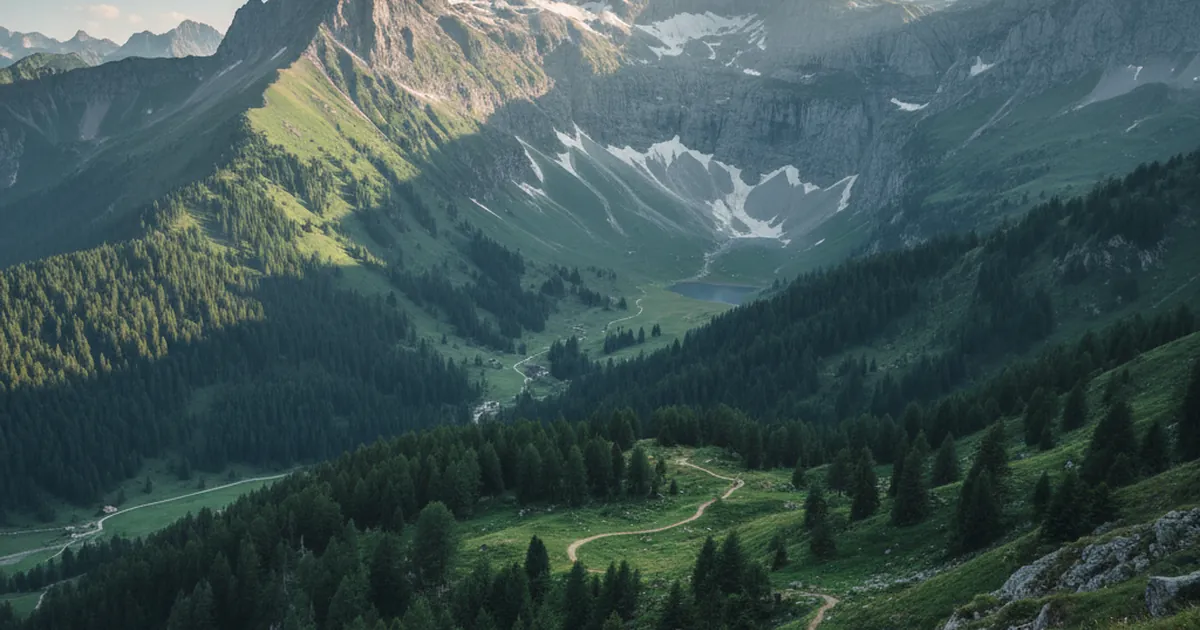
The Giffre Valley stretches from Taninges all the way to the cirque of Sixt, passing through Morillon and Samoëns. It packs trails for every level without ever feeling overcrowded, making it one of the best places to start hiking in Haute-Savoie if you don't know the area yet. Here's how to find your bearings.
One valley, several distinct areas
The Giffre Valley is not one uniform landscape. As you head up from Taninges, the scenery shifts quickly: open meadows around Mieussy, forested slopes above Morillon and Samoëns, and then the towering limestone cliffs closing off the cirque at Sixt-Fer-à-Cheval. Each section of the valley has its own trails, its own elevation gain, its own atmosphere. The basic principle: pick a sector first, then pick a level. Don't try to cover everything in one stay.
Easy walks for beginners and families
The Giffre Valley offers genuinely accessible routes, not just "less hard" ones. Two solid options for a first outing:
- The Tour des vallons bord de Giffre, starting from Samoëns: 7 km with just 32 metres of elevation gain, completed in about 1h25. You follow the river and cross the meadows near the village. A perfect warm-up, especially before a harder day.
- At Morillon, the Les Miaux and Le Châtelard loop covers 4.3 km and 136 metres of elevation, done in just over an hour. A quiet, partly shaded trail with fine views over the village and its chalets.
Neither route requires any technical gear. A solid pack, enough water, and proper footwear are all you need.
Two hikes for a proper day out
If you have a few outings under your belt and want a real half-day or full-day challenge, the valley has plenty to offer at moderate level.
- Les Esserts from Morillon: a loop of 9.7 km with 519 metres of elevation gain, around 2h45 of walking. Starting from La Cuttaz, the trail alternates between forest sections and open meadows, returning via a different slope. A good balance of effort and scenery.
- Le Bout du Monde at Sixt-Fer-à-Cheval: 9.8 km and 377 metres of elevation gain, estimated at 2h35. Starting from the chalets de Frénalay, the trail ends in a dramatic enclosed setting of cliffs and dense forest that more than earns the name ("The End of the World").
The Gorges de Tines: a natural highlight worth stopping for
Sixt-Fer-à-Cheval holds several natural features found nowhere else in the valley. The Gorges de Tines are one of them. Two options depending on how much time you have:
- The Gorges des Tines circuit alone: barely 2 km with 158 metres of elevation gain, about 40 minutes round trip. A quick but memorable immersion into the gorge, accessible to almost everyone.
- The Anciennes Gorges de Tines et Le Mont route: 7.1 km, 383 metres of elevation gain, two hours of walking. The difficulty stays easy, but the route goes further and rewards you with much better viewpoints.
For experienced hikers
The Giffre Valley also opens onto genuinely demanding days out. The Montée au Criou from Samoëns is the prime example: 17.7 km and 1,607 metres of elevation gain, taking around 6h10. Rated very difficult, it is aimed at walkers comfortable with long mountain days. There are no reliable water sources along the entire route, so plan your supply accordingly.
Further challenging routes exist around Sixt-Fer-à-Cheval, heading toward the high pastures and mountain lakes. These paths typically don't open until June, once the snow has cleared. Always check conditions before you go.
Using the villages as base camps
Choosing the right village as your starting point shapes the whole day. A few reference points:
- Taninges: the valley's gateway, well-equipped, and a solid base if you're spending several days in the area.
- Samoëns: the main village in the valley, with a wide range of trails right on its doorstep. Easy access via the main valley road.
- Morillon: quieter atmosphere, well-suited to families. Trails start directly from the village.
- Sixt-Fer-à-Cheval: at the far end of the valley, the launching point for the wildest routes. Stock up on supplies before you arrive.
The Giffre Valley rewards more than one visit. Start with one sector, get a feel for the terrain, and come back. The trails are open through the season, from June to October for most of them.