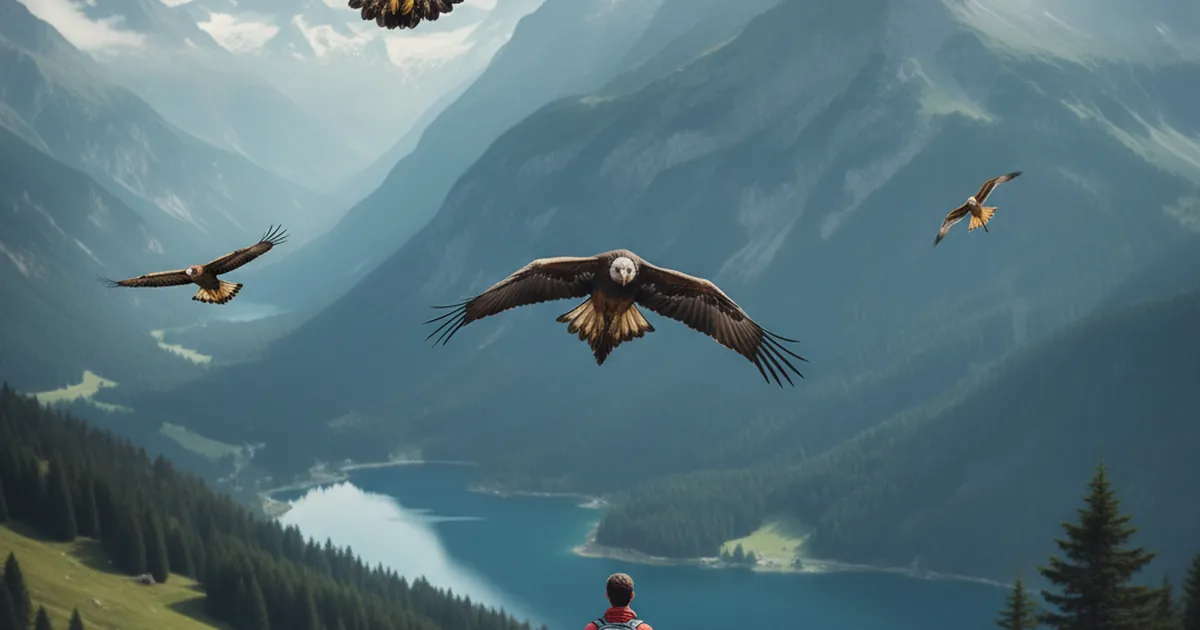
You round a rocky bend, look up, and spot a silhouette hanging motionless in the blue sky, wings spread wide. Golden eagle? Common buzzard? Bearded vulture? When hiking in Haute-Savoie, crossing paths with a raptor is one of those moments that stays with you. Knowing which bird you're looking at makes it even better. Here are the key identification features, no ornithology degree required.
Golden Eagle: King of the Ridges
This is the raptor everyone hopes to spot, and once you do, there's no mistaking it. The golden eagle has a wingspan that can exceed two metres. In soaring flight, its long, broad wings are held in a slight V, and its tail is short and rounded. It rarely beats its wings, relying instead on thermals and updrafts to stay aloft, tracing long, lazy circles above cliff faces.
Beginners often confuse it with the buzzard, but the size difference is enormous. The eagle is massive, dark brown overall, with a distinctive golden nape when seen at close range. It nests on inaccessible ledges far from trails. Give cliff bases a wide berth during the breeding season, which runs from February to July.
Bearded Vulture: Ghost of the High Cliffs
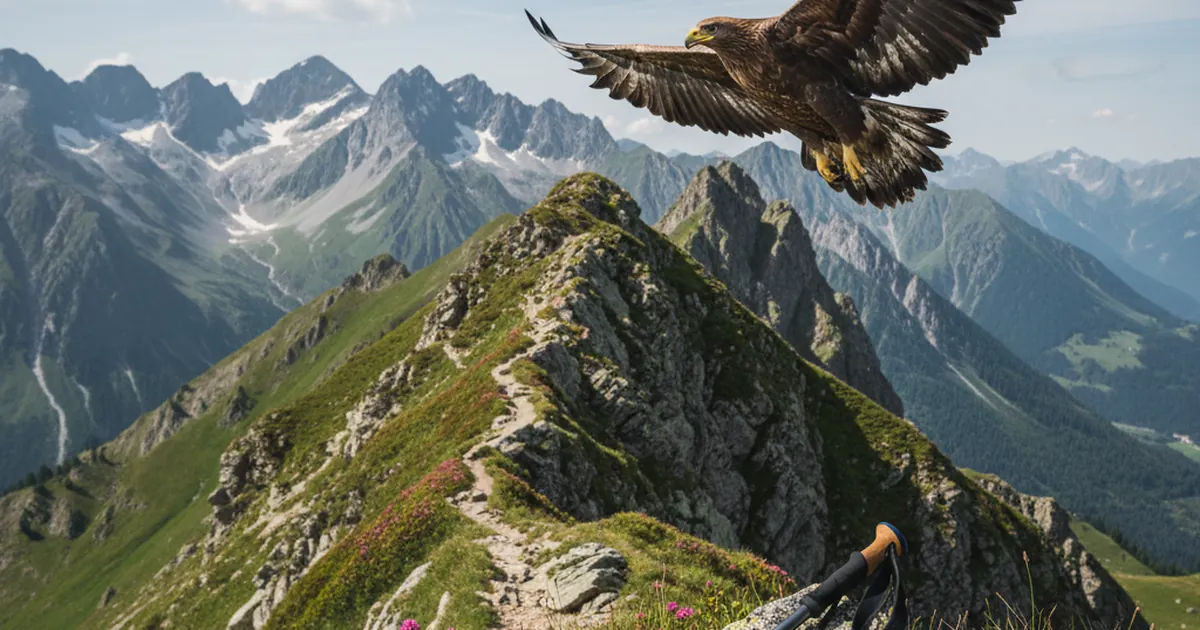
This is the most spectacular raptor in the Alps. The bearded vulture is among the largest raptors in Europe, with a wingspan of up to 2.80 m. Its silhouette is unmistakable: long, narrow wings, a diamond-shaped tail, and a small head thrust forward. Adults display a striking rusty-orange underside, a tint the bird actively maintains by bathing in iron-rich springs.
The bearded vulture is a bone specialist: it carries bones high into the air, then drops them onto rocks to split them open and access the marrow. It favours high-altitude cliff faces and limestone massifs. In the Giffre valley, sightings are regularly reported in the most remote sectors. The Lac de Gers and Refuge de Sales hike takes you into exactly this kind of terrain, with good chances of an encounter at altitude.
Common Buzzard: The Everyday Raptor
The common buzzard is probably the raptor you will encounter most often on the trail. Its French name, "buse variable," reflects its highly variable plumage, ranging from dark brown to almost white, with many intermediate forms. In soaring flight it looks stocky, with broad, rounded wings and a short, fan-shaped tail. It typically circles over woodland edges and open fields, hunting voles and mice.
Its hovering flight, head-into-the-wind, is often mistaken for that of a kestrel. The main difference comes down to size: the buzzard is significantly larger, with much broader wings and a rounded tail, while the kestrel has a long, tapered tail and a quicker, more agile movement.
Red Kite and Black Kite: Spot the Forked Tail
Kites are the only European raptors with a clearly forked tail, which makes them easy to identify at a glance. The red kite is larger, with a wingspan of around 1.50 to 1.85 m, warm rufous-brown plumage, and a deeply forked tail that resembles open scissors. The black kite is duller and more greyish, with a shallower fork.
Both are acrobatic fliers: their flight is buoyant and flexible, with constant twists of the tail for steering. The red kite partly overwinters in Haute-Savoie before moving back to nesting grounds in spring. The black kite arrives from Africa in April and departs by August. Over the sunny slopes of the Mont Blanc area and the Aravis range, you can watch them hunting above meadows in May and June.
Kestrel and Peregrine: Speed and Precision
These two falcons share little beyond their family. The kestrel is the small raptor that hovers in place, head perfectly still against the wind, tail fanning slowly. It hunts by sight over grassland and roadsides. The male has a grey head contrasting with a chestnut-brown back spotted with black.
The peregrine is a dedicated aerial hunter that catches its prey in high-speed dives. It nests on cliff faces and takes birds in flight. Its silhouette is sickle-shaped: short, pointed wings, a stocky body, and a broad head with distinctive dark moustache markings. On the Rochers de l'Aigle hike, the rock faces provide ideal nesting conditions for resident pairs.
Practical Tips for Better Observation
- Bring binoculars (8x42 is ideal): they make all the difference for identification.
- Mid-morning is the best window, when thermals start to build over the slopes.
- Position yourself on high ground with cliffs behind you: you will often get eye-level or even downward views of raptors circling below.
- Focus on wingspan and tail shape rather than colour alone, as plumage varies widely within the same species.
- Spring and early summer are peak season: juveniles making first flights, adults hunting hard to feed their young.
Learning to identify raptors adds a whole new dimension to every outing. Next time you are out hiking in Haute-Savoie, take a moment to look up, note the silhouette, the flight style, the size. With a little practice, you will start recognising them at first glance.